The River as Refuge
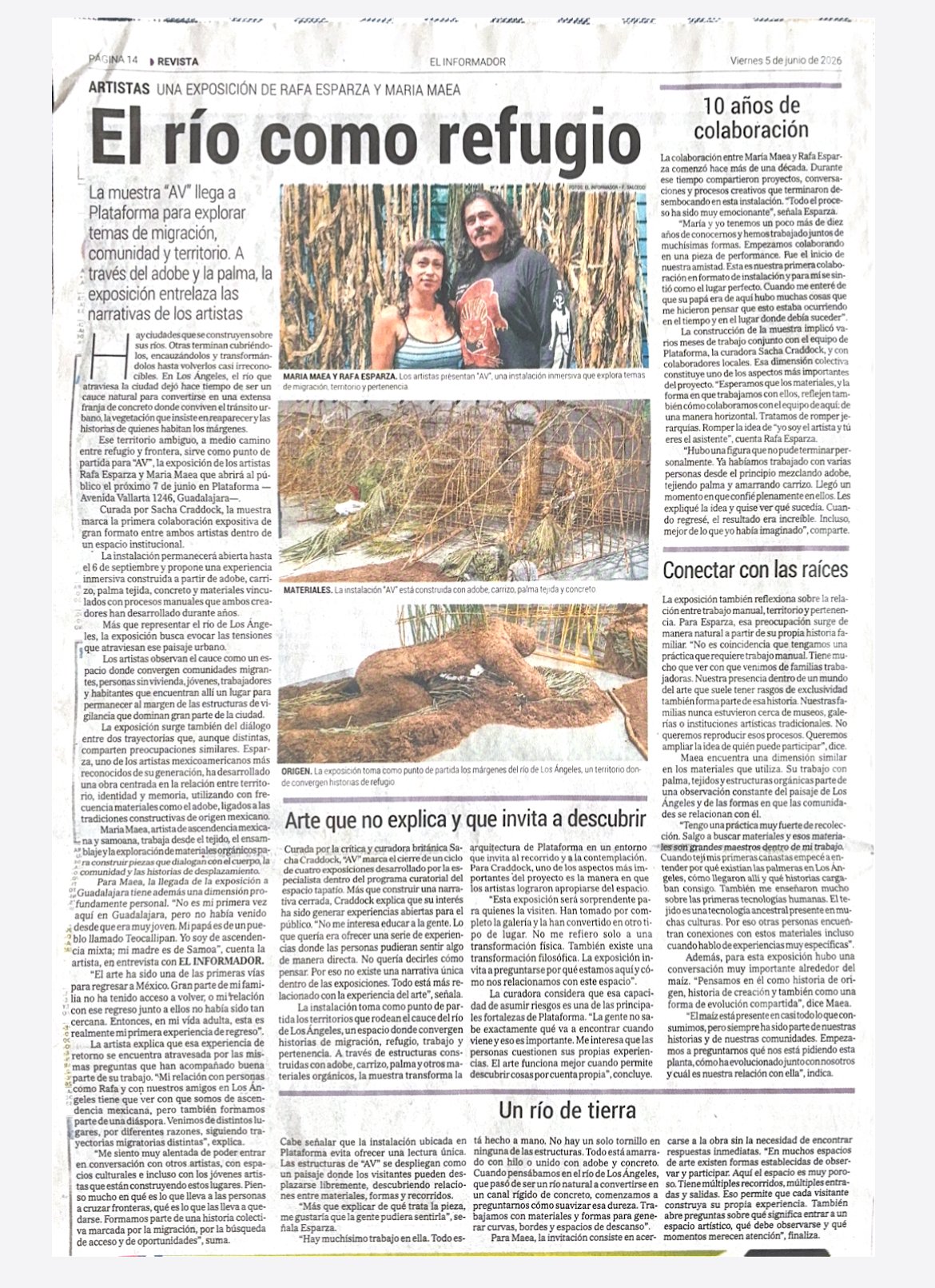
El Informador
Guadalajara, Jalisco, Mexico
5 June 2026
Link to press article
English Translation
The River as Refuge
An exhibition by Rafa Esparza and María Maea
The exhibition "AV" arrives at Plataforma to explore themes of migration, community, and territory. Through adobe and palm, the exhibition intertwines the artists' narratives.
Aqueducts are built over rivers. Others cover them, channel them, transform them into roads and unrecognisable infrastructures. In Los Angeles, the river ceased long ago to be a natural watercourse and became an extensive concrete channel, a place of transit and abandonment, a site that nevertheless preserves the stories of those who live along its margins.
This ambiguous territory—half refuge, half border—forms the starting point for "AV," the exhibition by artists Rafa Esparza and María Maea, which opens to the public on 7 June at Plataforma (Avenida Vallarta 1246, Guadalajara). Curated by Sarah Craddock, the exhibition marks the first large-scale institutional collaboration between the two artists.
The installation will remain on view until 6 September and offers an immersive experience constructed from adobe, reeds, woven palm, and concrete—materials deeply connected to the personal histories that both artists have developed over many years.
More than representing the Los Angeles River, the exhibition seeks to evoke the tensions that run through it.
The artists see the riverbed as a space where migrant communities, people without homes, young people, workers, and inhabitants who have found a place to remain coexist on the margins of the surveillance structures that dominate much of the city.
The exhibition also emerges from the dialogue between two artistic trajectories which, although distinct, share similar concerns. Esparza, one of the most recognised Mexican-American artists of his generation, has developed a body of work centred on the relationship between territory, identity, and memory, frequently employing adobe—a material linked to Mexican vernacular building traditions.
María Maea, an interdisciplinary artist and Samoan weaver, works from the language of organic materials to create installations that bring together body, community, and histories of displacement.
For Maea, arriving in Guadalajara to present the exhibition has also been a deeply personal experience.
"This isn't my first time in Guadalajara, but I hadn't been here since I was very young. My father is from a small town called Teocaltiche. I have Mexican ancestry; my mother is Samoan," she explains during an interview with EL INFORMADOR.
"Art has been one of the ways of returning to Mexico. A large part of my family has no relationship with art, and my return to them had never been so close. In many ways, this is my first real experience of coming back."
The artist explains that this sense of return is woven through many aspects of her practice.
"My relationship with people such as Rafa, and with our friends in Los Angeles, has shown me that although some of us have Mexican ancestry, we are also part of a wider diaspora. We come from different places, for different reasons, following different migratory paths."
"I feel very fortunate to be able to engage in conversations with other artists, in spaces where the very things that keep us apart become the things that unite us: what leads people to cross borders, what brings them together. We form part of a collective history shaped by migration, by the search for opportunity, and by rivers that build themselves over other rivers. Some are buried; others are redirected and transformed into roads. In Los Angeles, the river became a place that preserves the stories of those living on its edges."
Art That Doesn't Explain but Invites Discovery
For curator Sarah Craddock, AV is not an exhibition that seeks to provide definitive answers. Rather, it offers visitors an opportunity to encounter the work through their own experiences and associations.
"The exhibition doesn't try to explain everything," Craddock says. "Instead, it creates a space where people can make their own connections. The works are rooted in the artists' personal histories, but they also open onto broader questions about belonging, migration, landscape and community."
The curator explains that one of the strengths of the collaboration between Rafa Esparza and María Maea lies in the way their practices intersect without losing their individual identities.
Although they work with different materials and draw upon different cultural traditions, both artists are deeply engaged with questions of place, ancestry and the ways in which histories are carried through material and craft.
The exhibition unfolds as a conversation rather than a narrative. Visitors move through an environment built from natural materials that evoke architecture, landscape and shelter, encouraging moments of reflection rather than directing a single interpretation.
Craddock notes that the project has grown through dialogue over many years and that the exhibition reflects a sustained exchange between the artists rather than a one-off collaboration.
"The work invites people to slow down," she says. "It asks us to consider how we inhabit places, how we remember them, and how communities are formed through shared experiences."
Ultimately, AV proposes that art need not provide certainty. Instead, it can create the conditions for conversation, curiosity and discovery.
10 Years of Collaboration
The collaboration between Rafa Esparza and María Maea has developed over the course of more than a decade. Throughout those years they have shared conversations, projects, and a growing artistic dialogue that has evolved naturally through friendship and mutual respect.
Rather than beginning with a fixed concept, their collaborations have emerged from an ongoing exchange of ideas, experiences, and materials. AV represents the culmination of that process, bringing together two distinct artistic practices in a shared installation while allowing each artist's individual voice to remain clearly present.
For both artists, collaboration is not simply a way of producing work but a method of thinking—one rooted in listening, generosity, and the willingness to allow unexpected connections to emerge.
Connecting with Roots
For María Maea, returning to Mexico has been both an artistic and deeply personal experience.
Although she has lived much of her life in the United States, her father's family comes from Teocaltiche, in the state of Jalisco, while her mother is Samoan. This dual heritage informs much of her practice, which frequently explores identity through traditional weaving techniques and natural materials.
Working alongside Rafa Esparza has also allowed her to reflect on the shared experiences of communities shaped by migration.
Rather than treating identity as something fixed, Maea sees it as something continually constructed through family histories, movement across borders, memory, and the relationships we build with others.
A River of Earth
One of the central materials in the exhibition is adobe.
For Rafa Esparza, adobe carries meanings that extend far beyond its practical use as a building material. It embodies labour, family knowledge, ancestral memory, and the possibility of creating spaces of shelter and belonging.
Combined with Maea's woven palm and organic forms, the material creates an installation that feels both architectural and deeply human.
The exhibition ultimately proposes another way of understanding landscape—not simply as geography, but as something shaped by memory, migration, and the lives of those who inhabit it.
Rather than presenting the river as a fixed image, AV invites visitors to experience it as a living space: one that carries histories, welcomes encounters, and continues to transform over time.