SPIEGEL | Entry using a chisel
SPIEGEL
By Solveig Grothe
July 19, 2010, 2:17 PM
Link to article
London in the seventies
Entry using a chisel
Life the rough English way: London's squatting scene offered a home to everyone in the 1970s – the homeless, young gay men, houseless students, even the wanted RAF terrorist Astrid Proll. In a book, she shows photos from this parallel underground world.
"Am I safe from the police here?" The flatmates were taken aback by the strange question from the tomboyish girl who stood in the doorway and wanted to move in with them. A young German woman, 26 years old, with hardly any luggage. Astrid Proll had come to London in August 1974 with only an address in her pocket. She was looking for a place to stay and wanted to attract as little attention as possible. She was on the run. A man had taken her to Camden Town.
She was able to stay in a squat, an illegally occupied house in the north of the British metropolis. It was an ideal place—because no one asked for papers there. The young German woman had entered the country with a forged passport. She was wanted on an international arrest warrant as an "anarchist violent offender" of the Baader-Meinhof Group. In 1970, the architect's daughter from Kassel had joined the Red Army Faction (RAF), and about a year later she had been arrested in Hamburg. In 1973, she had stood trial in Frankfurt for attempted murder and bank robbery, but had been released from custody due to life-threatening circulatory problems—and disappeared. Now she would go underground in London's squatting scene.
The British metropolis was in a state of near-surgeon at the time. The squatters, London's squatters, had taken what they hadn't been given: tenements, villas, empty shops. After years of failed housing policies, the city was in turmoil: as recently as the late 1960s, tens of thousands of London families had lived in slums and makeshift welfare accommodations. The dilapidated buildings had been cleared, but the city couldn't keep up with the demand for new housing. At the same time, many houses stood empty – properties owned by real estate speculators. Public discontent grew, particularly regarding the planned demolition of historic buildings. Squatters tried to prevent this and encouraged homeless people to move into these buildings. By the mid-1970s, they controlled approximately 30,000 houses. As soon as one building was cleared, the squatters moved into another. London's police force capitulated.
Free, illegal, happy
Proll found these circumstances quite convenient. "London was a liberation, the city a stroke of luck for me," recalls the now 63-year-old, "in this huge multicultural conglomerate, where you didn't even need an ID, I didn't stand out."
The former RAF activist brings the era back to life. In her 2010 book "Good bye to London," published by Hatje Cantz, she has compiled previously unpublished photographs from that time, gives voice to contemporary witnesses, and paints a picture of a 1970s "counterculture" that, in the collective memory, is "unjustly" overshadowed by the 1968 student revolt and the punk movement that began in 1976. For this very period, she argues, was "crucial for the liberalization of British society." Unlike in West Germany or Italy, for example, the radical left in Great Britain was rather weak, Proll observes, and alternative London was more strongly characterized by solidarity—and thus probably more compatible with mainstream society.
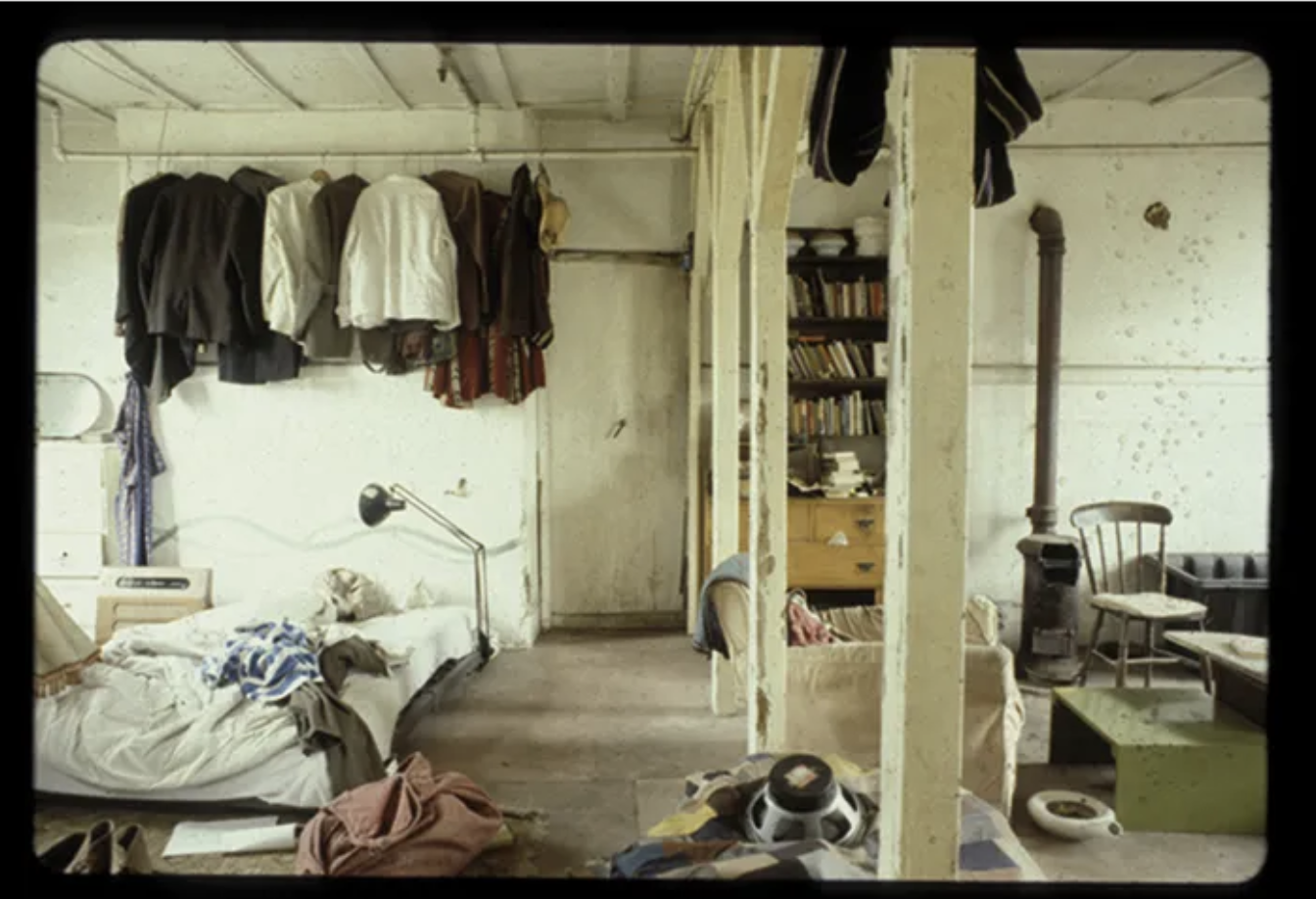
Nick Wates' color photographs depict a kind of late Flower Power idyll. Wates, who now lives in the English seaside resort of Hastings as an architect and urban planner, was himself a squatter and something of a chronicler of the scene around Tolmers Square near Euston Station. His pictures from 1975 show young people with long hair and baggy trousers sitting in the street: a peaceful protest against the eviction of the occupied neighborhood in north London. Other photos document the interiors of the squatter quarters: disheveled beds, worn armchairs, clothes hanging from exposed water pipes.
Live simply
"Our life was pretty simple," Tolmers resident Sacha Craddock writes in her memoirs: "There was water, but no bathtub or shower and no sink other than the kitchen sink." The sewage system in Tolmers was more than modest: "We dumped all the wastewater into a huge tin tub, which we then emptied out of the first-floor window into the backyard."
Craddock had just finished her A-Levels, the English equivalent of a high school diploma, when she and her boyfriend squatted in their first house – apparently according to rather conventional criteria: The building was located on Drummond Street, near the tube, between the city's first Indian vegetarian restaurant and a small corner shop, "and we chose it because it looked nice." The move-in, however, was anything but conventional: "We broke into our house with a crowbar," and "once we had taken possession of it, we never locked the door again."
Unemployed people and students, artists, drug addicts, women and children of diverse nationalities – they could all be found in the squats. While some pursued regular employment, others increasingly dedicated themselves to political struggle – not just for public housing. The women's and gay rights movements also formed within the squatters' scene.
Everything was shared – including the partner.
"Gay people came to the squats for many different reasons," explains archivist and eyewitness Ian Townson. Some had fled their old lives, others were simply glad not to have to live in isolation after coming out. "There were many visitors from overseas. Everything was always shared, including sexual partners."
It was a very open society that gathered underground – as Townson's collected photographs also show: open doors, torn-down garden walls, communal gardens. Peter Cross, then 25 years old, moved into one of the gay houses in Brixton in 1975: "When you came home on a long, hot summer evening, there were at least ten people sitting around the table in the garden – there were candles, food, cigars, wine, a guitar or a violin."
Cross remembers one night in particular: "About five of us had sex for hours on someone's big bed. We traced the outlines of our shadows on the wall with a pencil; they stayed there for a while and were then covered with political posters and Art Deco cloths."
Farewell to the parallel world
The occupied houses had become "a kind of parallel world" for Cross—and not only for him. For Astrid Proll, too. In September 1978, four years after her arrival in London, her life of illegality and freedom suddenly came to an end. Someone had recognized the young woman, who had most recently worked as an instructor in a car repair shop. The German woman, now dubbed "Miss Terror" by the London newspapers, was arrested.
Her British comrades, however, stood by her. In Brixton prison, she received daily visitors; friends brought her food. One of those who cooked for her was the young gay man Peter Cross. A year after her arrest, Proll was extradited to Germany. On February 22, 1980, the court sentenced her to five and a half years in prison for robbery and forgery, a sentence that was suspended after time served in pretrial detention was taken into account. Since then, Astrid Proll has worked as a writer, photographer, and editor for various media outlets.
Alternative London, too, was heading towards change at the end of the 1970s. The election of the conservative Margaret Thatcher as British Prime Minister in 1979 is seen by many former squatters as a definitive break. The country experienced an economic boom, and property prices in the metropolis soared. Houses were renovated – and although social housing was also created in the process, young people in particular disappeared from central London.
Sacha Craddock, now a curator in London, recalls the moment she moved out: "The piano was taken downstairs, and a friend was still playing it outside the house." A few days later, she took the bus past her old apartment again. The house had been demolished, a hole gaped in the wall, revealing the wallpaper. "It was heartbreaking."