JACK MILROY | BIBLIOPHILIA
Shapero Modern, 15 April - 15 May 2026
© Sacha Craddock, March 2026
Jack Milroy
Broken out of perhaps an educative or sometimes decorative function, these two-dimensional representations of usually three-dimensional objects, cut from a glossary or guide, cover a generic range. The subject, as such, or incidental as it might be, is allowed at most to suggest a direction the work might take. The material lends itself to, as well as determines, the physical as well as associative moves the artist may follow.
Milroy will at times paint a background that somehow contrasts with the graphic particularity of the ‘raw’ material, for instance, or he might, on the other hand, lay a base of rocky tissue as a suggested continuation of a context itself. Kept to a shallow vitrine of its own category, the delicate reference, is also at times mixed with totally different images, instance, like that of a postcard of fine art reproduction.
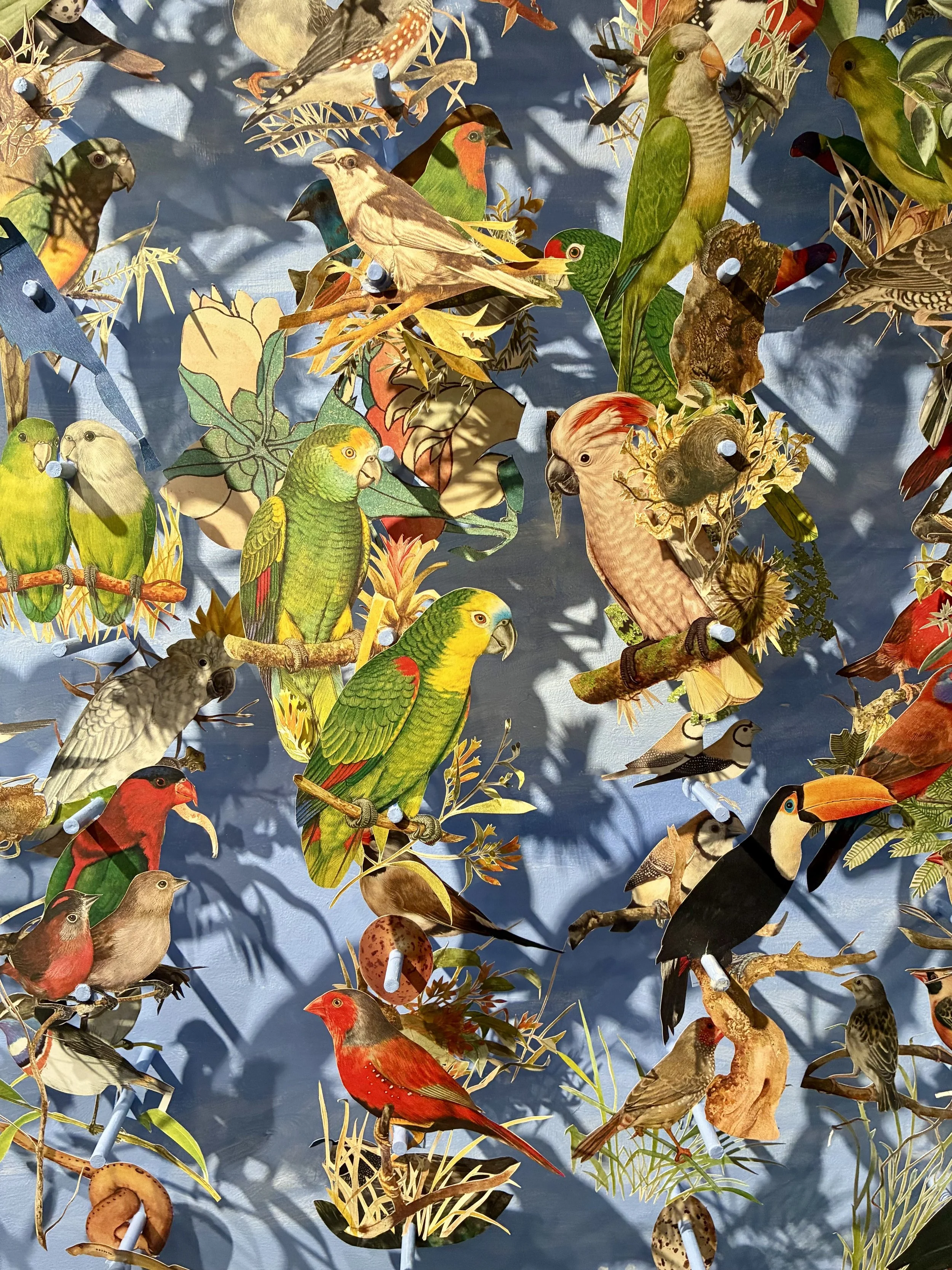
Neither innocent nor overdetermined, moving from page to page, leaving a wedge of negative space, the illustrated front pushes through the page or card. A kingfisher, or singing toad, becomes part of a decidedly lightly touched melee. Milroy mainly, through necessity, utilises the regular beat of the page. Apart from the unconscious sense of a flickering film, there seems to be no grand significance in the relationship between individual works. Milroy is not starting from the beginning, each time, however, but rather seems to intervene in an apparently innocent raw space, with material that already has identity. The negative space, from which the material has been cut, means that the artist starts, with a different, yet the same, idea, in order to set off an often humorous relationship between image and the shape that the image happens to make.
From early days of indulgent colour print, the combination of simple, sometimes exquisite illustrations drawn with crisp outline and cut so diligently, carries a tangled intricate logic. Blurred but helped still through intervention, the birds, flowers cartoon, historical and Modern art, from postcards, or even the strands from paint in a Pollock painting have been excavated, as such, to be reconfigured in shallow three dimensions. Delicacy hovers between the power of association and the source of the material. With the apparently neutral nature of illustration, Milroy seems to suggest the fluttering of pages in the wind.
Each vitrine at times seems full of cut-out elements appearing like strokes in a pointillist, or cubistic, images, with a flickering of reproduced printed colour. It is also suggesting something continuous in terms of direction yet deliberately limited in formal terms. The heightened colour from popular and valuable books, or a combination of the two, carries an inbuilt rationale of the book from a perhaps more simplified time of categorization.
The colour, also, recalls a period of easy reproduction and education for all. There is no waste, as the object - or subject - of a reproduced Japanese print, for instance, cut around and placed in a shallow vitrine, achieves an animated relief. Each vitrine is imbued with a different extended world that unfurls in relation to the regular pace and beat, in turn, of the page.
The origin might seem to provide the continuation of an idea. Material for both a hanging and climbing plant, for instance, becomes a meticulously constructed mass that flows down, as well as up, with detailed delicacy from one level to the next, and then the other way around. The material lends itself to the way it is used. Balancing, holding, suspending, honing, underpinning, perhaps even delicately forcing, Milroy follows or finds, through an action, nonetheless, a sort of serendipity in relation to the logic of the source. Fish, helicopters, underwater colours, tulips, arrive already described, as ready-mades. Found image is turned into found object. Sometimes the direction of a piece is suggested by the title of a book as the bird is released from the page.
A leaning, revealing, flowery finesse, means that elements come out in perpetual relation to each other and gather phenomenological force. A plant grows, somehow, while a flying machine war machine is interspersed to suggest a surreal state that carries a sense of collapse within it. In the same way that an uncut stone will carry the subject, or the bare canvas will already have a point, Milroy hopes to release what is already there through such manipulation of image and sculptural element.
With subject denied, he remains part of a somewhat conceptual tradition where materiality wins out. By drawing attention to - and bringing into focus - what has been and is still there the artist, who nonetheless retains a deceptive nonchalance, rearranges without false claim.
Sacha Craddock, March 2026