Conversation Expands the Mind | Latvijas Avīze
Latvijas Avīze
Riga, Latvia
21 October 2002
English Translation
Conversation Expands the Mind
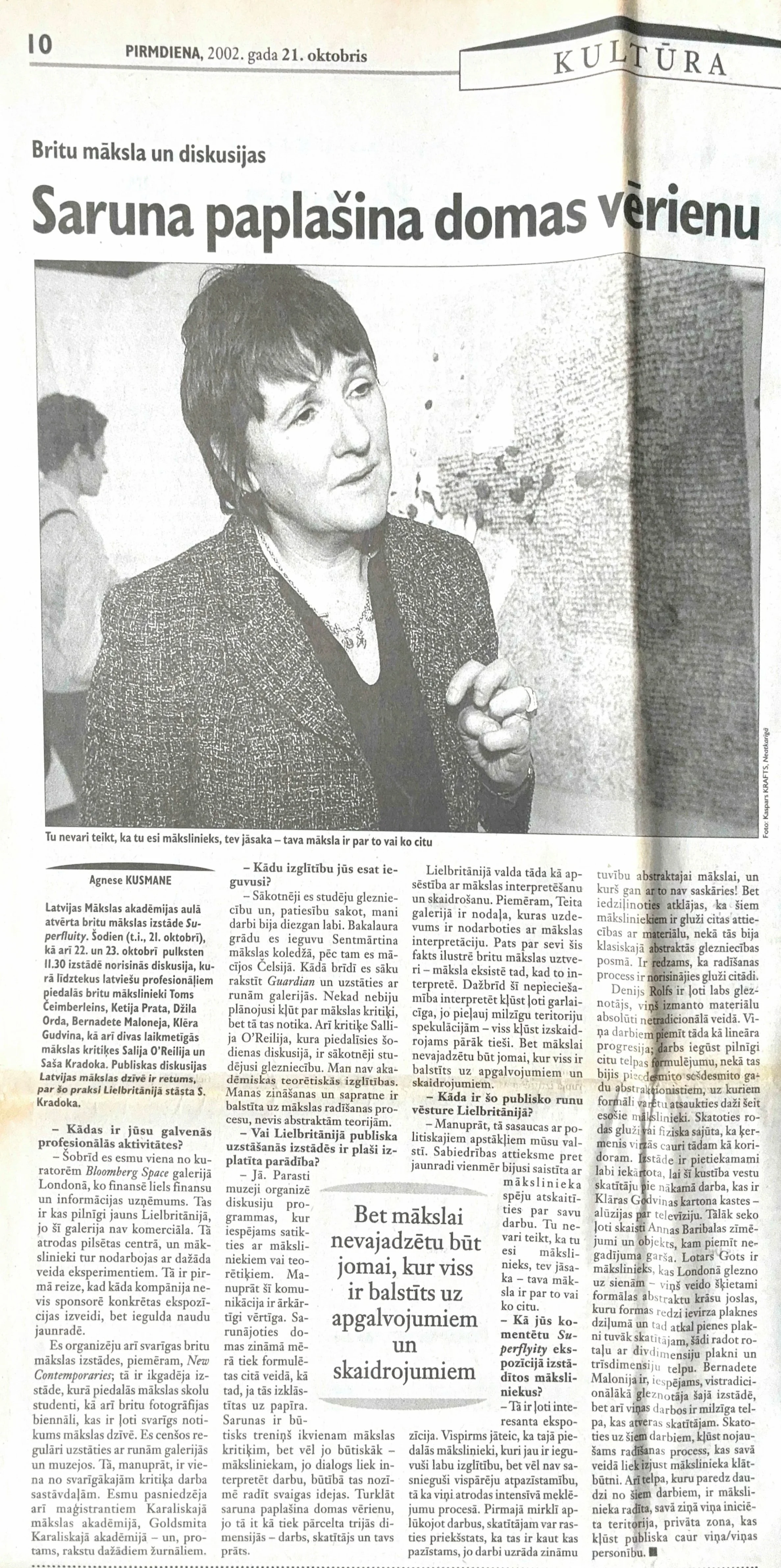
Interview with British art critic Sacha Craddock.
By Agnese Kusmane
To accompany the opening of the British contemporary art exhibition Superfluity at the Latvian Academy of Arts, several British artists and critics gathered in Riga to discuss their work and the role of contemporary art. Among them was acclaimed British art critic Sacha Craddock, who reflected on her career, Britain’s approach to art, and why conversation is essential to artistic practice.
Your work spans many different areas. How would you describe what you do?
I work as a curator at Bloomberg Space in London, a gallery funded by Bloomberg. It’s an unusual institution because, although it is supported by a large corporation, it isn’t commercial. Instead, it gives artists the freedom to experiment and develop new ideas.
I also organize major exhibitions, including New Contemporaries, an annual exhibition showcasing emerging artists, as well as Britain’s Photography Biennale. Alongside curating, I lecture in galleries and museums, teach postgraduate students at the Royal College of Art and Goldsmiths College, and write for a range of art publications.
Did you always intend to become an art critic?
Not at all. I originally trained as a painter and completed my studies in fine art. I never planned to become a critic, but while I was still studying I began writing for The Guardian and speaking in galleries. Gradually, writing became my profession.
Interestingly, many art critics—including my colleague Sally O’Reilly—first studied as artists. My understanding of art comes less from academic theory and more from firsthand experience of making it. That practical background shapes the way I write and think about art.
Public talks seem to be an important part of British exhibitions. Why is that?
Britain places enormous emphasis on interpreting and explaining art. Institutions such as Tate even have departments devoted specifically to interpretation.
While explanation can be valuable, there is also a danger that art becomes buried beneath endless commentary. Sometimes every detail is analyzed so thoroughly that viewers are left with little room to form their own responses.
Art should not become something that exists only through explanations and arguments.
Why have discussions become such an important tradition?
I think it reflects British culture more broadly. Society expects people to explain their ideas and defend their work.
Museums and galleries regularly organize talks, lectures, and educational programs because discussion helps people engage with contemporary art. Speaking about ideas often clarifies them—not only for audiences but for artists themselves.
Artists frequently discover new ways of thinking simply by talking about their work. A conversation forces them to articulate ideas they may never have consciously expressed before.
That is why I believe conversation expands the mind. It creates a dialogue between the artwork, the artist, and the audience, allowing each to influence the others.
What unites the artists in the exhibition Superfluity?
This exhibition presents artists who have already established themselves professionally but are still exploring and experimenting. Rather than following conventional approaches, they push materials and artistic processes in unexpected directions.
Some works appear familiar at first, but closer attention reveals highly individual approaches to form and meaning.
Among the participating artists:
* Dennis… (the newspaper text is partially obscured) transforms everyday materials into unconventional sculptural forms.
* Chris Garside creates installations using cardboard boxes, turning ordinary packaging into architectural compositions.
* Anna Barriball is known for subtle drawings and objects that invite careful, patient observation.
* Lotar Götz paints large geometric murals that alter viewers’ perception of architectural space.
* Bernadette Moloney works within painting but creates powerful spatial experiences that draw viewers into the image.
Although each artist works differently, they all establish deeply personal visual worlds. Through their work, they create private territories that become public once they are shared with an audience.