Omelette and Muscadet with Sacha Craddock
In conversation with Tali Silver
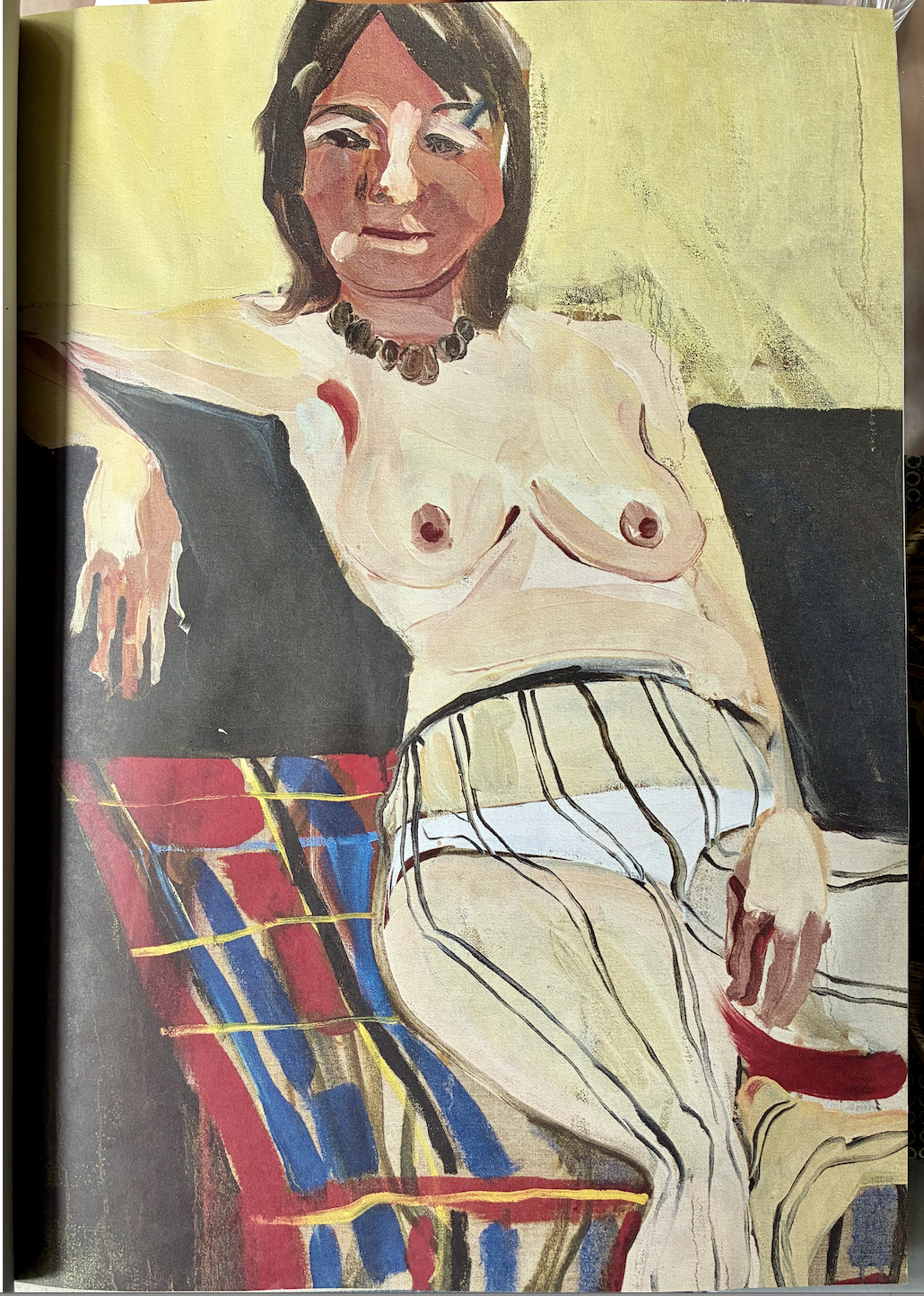
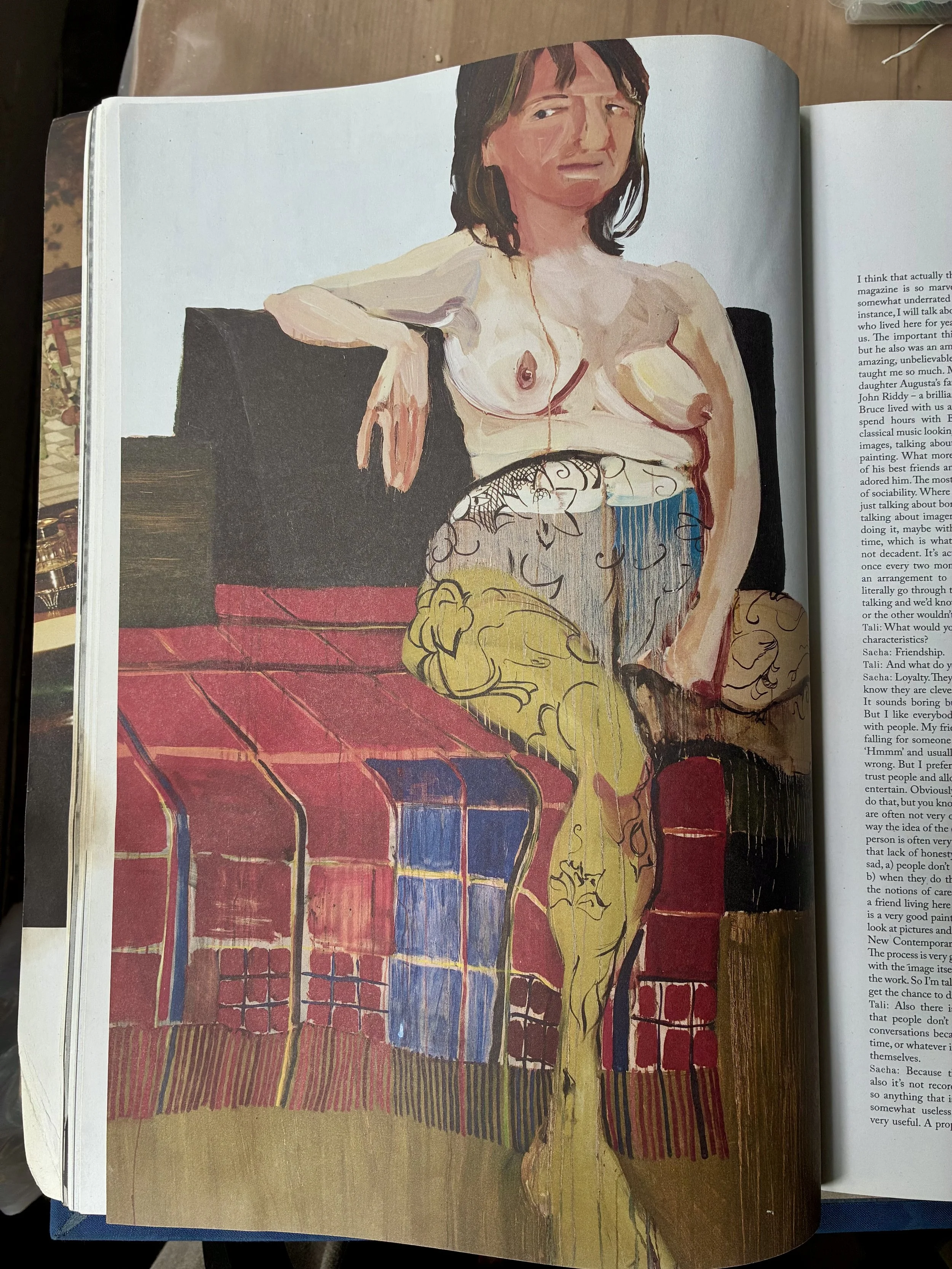
Paintings by Chantal Joffe
Autumn-Winter 2016-2017
An independent art critic and writer of great influence, Sacha Craddock lives in a large townhouse next door to the British Museum in Bloomsbury, London. It is a communal household where she has enjoyed the company of numerous distinguished residents such as Isaac Julien and Mark Nash, Bruce Bernard, Atilio Lopez and Cora Pearlman, to name but a very few. Craddock has been the chair of Bloomberg's New Contemporary selection committee over the last 20 years, has contributed as a critic for The Guardian and The Times and has judged many prizes, such as The Turner Prize in 1999. On a sunny Friday Sacha Craddock invited us to lunch, and over lemony asparagus, omelette and wine we talked about radical politics, communal living, art, and above all, friendship.
Tali Silver: When is wine important? In communal living or generally?
Sacha Craddock: I think generally. And what do you think the point is?
Tali: Part of the secret to good communal living is lots of wine.
Sacha: Generally, there are the people you keep out of the communal situation. There are people who go mental with drink and then there are people who can drink forever and be lovely. I hope I'm one of those. You must know that whatever you do, whatever you drink, you know that you can trust that you've not been bad. Do you know what feeling? When you're young you think ‘what the hell did I do?' But the important thing is to always be polite, always include everyone who happens to be at the same place at the same time. Never differentiate – it's a waste of time. So when you're here, that's it. But the notion of communal accountability and openness is a complete myth. Just as much of a myth as ideas of freedom in art.
Tali: Or freedom in life?
Sacha: Exactly. Freedom in life. The idea that you really are free, that you can express yourself, I mean that false idea of expressionism... If you apply that to relationships, you're in trouble.
Tali: In Israel, where I'm from, there's this idea of a Kibbutz, which is communal but slightly different because it isn't each member that has their own property, it never belonged to them personally, they all work for everybody else, they shared the burden and the successes. And the same in bringing up kids, everybody is everybody's kids. Sadly, Kibbutz is an idea of social experimentation but a failed system.
Sacha: We're not even talking about the Kibbutz thing, but the idea that children are shared or that people live more communally or they have their older people about, that has disappeared and everyone's very isolated. And honestly, I've always wanted to have a child all my life but I knew I wanted to live in the centre of London and communally in order to have a child. I really thought of it that way. I would not have gone to a house down the end of the street where you would not work and you would be left on your own and your partner would be the breadwinner. No way would I do that. So in a way, this kind of communal thing is very much about children as well. Because of a head injury I went to a very progressive school when I was young. I went to a school like Summerhill, which is a famous A.S. Neill progressive school – Monkton Wyld in Dorset. Incredible and totally liberal. You do what you want every day. It's all about self-generation and self-reliance and discipline and not being told anything, ever. Obviously, I adored it and when my parents took me away I swore I would never ever forgive them or speak to them again because I loved it so much. I became really disciplined at school. I started doing massively formal life classes of my own. So I literally set up still lifes and did academic drawing all day. I went to that school because of my head injury, because my parents believed in it. My parents always lived with other people because they couldn't afford the rent just themselves, so we always lived with other people. Often, economics make you communal.
Tali: Yeah, but also you made it your politics.
Sacha: Yes, I'm very political about that. Let's talk about this house. The story of this house began when you were at Tolmers Square...
Sacha: Yes, well a group of us, very close friends, squatted in Tolmers Square from 1973. Cora, who I still live with and who is one of my best friends, we squatted together all this time. I was very left-wing within the group and there are other people who are very communal so I would be the one going around saying we've got to make a document, we must Xerox these political papers to support the struggle. Then someone else would go around saying "Let's just collect some lentils". I would go, "What? How ghastly!" He was called Community Joe and we would go around in unison trying to get either lentils or money off people to support the struggle. One of the last campaigns we fought was housing for single people. If you had a council flat you didn't just have to be in a normal married situation, you could be gay, straight or whatever and you could live communally. So that was the beginning of a big campaign. People could live communally and the council could support it. We managed to fight that very well and actually did very well with the council. The person who was head of housing then was Ken Livingstone who was amazing, he was very good.
Tali: Ambitious?
Sacha: No, very good political instinct. Anyway, what I'm saying is he did this. We fought this really major campaign and there were some fantastic scenes and I have some photographs of Cora on our balcony writing banners saying, "Single people need it too." Eventually, in the struggle, we were evicted and the front page of The Observer had a picture of the whole house, the whole of Tolmers Square. It said, "London's most notorious squat evicted" and there were pictures of everybody along the balcony and somehow my mother managed to get in the picture. She never misses a trick. Never misses an opportunity. So then eventually the council said, "We have allocated a flat to you." So we went to the flat, walked into it and, oh my God, shock of shocks, it was squatted. So my friend Jamie went, "This is ridiculous!" Politically we fought a campaign for housing for people and now this is squatted with people lying on the floor saying, "Well, look man, we got here first." But now this isn't the kind of squatting we're talking about. We were notorious as a kind of radical household but always had posh dinner parties. We had people like Helena Kennedy and so on going "Oh it's marvellous, we've just been to see the wonderful people in Tolmers Square." We had Osborne & Little wallpaper in our squat and left-wing people turning up from all over the country, so it became like the place.
Tali: And when you were evicted you just spotted an ad in the paper that said...
Sacha: I saw an ad in the paper saying, "Large House Central London To Rent". A few of us said, "We are not moving to Stoke Newington! We're not going to have a pram in the hall and a bicycle on a hook in a hall. We're never going to be like that." It was sheer faith and belief. Totally. We just moved down the road from there to here.
Tali: Did you ever contemplate leaving or moving out?
Sacha: No.
Tali: Because I do wonder about the people that left, why would they leave such a scenario?
Sacha: Because they go abroad, they go home, they go away and so on. They want to live with a partner in some kind of situation. Isaac Julien moved out with Mark because they wanted to have their own scene, just live together. Isaac lived here for eight years. My dear friend Pierre Bismuth, the artist, lived here forever but went back to Belgium with his wife, Dessislava Dimova, who then came back independently to do philosophy. So a lot of it is really about friends that you love, having a relationship with London or needing to be in London. My friend whom you met, Alberto, Alberto Mira, who's a great expert on Spanish cinema, especially gay cinema, a major cinema historian and academic and one of my dear friends. He first stayed here with me in the 1980s when I didn't even know I was going to do art. And he was with his boyfriend who became a well-known critic, but we were all then just very far-left-wing people. So somehow we've all just carried on and done different things and now he's come back.
Tali: We all have little magnets but you have a massive one – for artists and intellectuals, everyone.
Sacha: Well, I think it's to do with being social and I think that actually the sociability, that's why this magazine is so marvellous because sociability is somewhat underrated as a kind of currency. So for instance, I will talk about my friend Bruce Bernard, who lived here for years and was a friend of all of us. The important thing was that he drank a lot but he also was an amazingly brilliant man and an amazing, unbelievable expert on photography. He taught me so much. My boyfriend at the time, my daughter Augusta's father, is a photographer called John Riddy – a brilliant art photographer. Anyway, Bruce lived with us and he and I and John would spend hours with Bruce drinking, listening to classical music, looking at images and talking about images, talking about photography, talking about painting. What more could you want? I was one of his best friends and he was one of mine and I adored him. The most important thing is that thing of sociability. Where you're with someone and not just talking about boring things like careers. You're talking about imagery and ideas and you're really doing it, maybe with drink, doing it over a long time, which is what this magazine is about. It's not decadent. It's actually totally constructive. So once every two months Bruce and I would have an arrangement to meet quite early. We would literally go through the day together, drinking and talking and we'd know we would carry on until one or the other wouldn't be able to any more.
Tali: What would you consider your most marked characteristics?
Sacha: Friendship.
Tali: And what do you most value in your friends?
Sacha: Loyalty. They are already your friends so you know they are clever. It's what you value in them. It sounds boring but loyalty is really important. But I like everybody very quickly. I'm very open with people. My friends and family always see me falling for someone immediately and they go like “Hmmm” and usually I'm right but God I can be wrong. But I prefer to try. It is very important to trust people and allow people in your house and to entertain. Obviously I live in a big house so I can do that, but you know, people who live in big places are often not very open about themselves. So that way the idea of the exterior person and the interior person is often very separated. And there's a sort of lack of honesty in that and it makes me very sad, a) people don't entertain at home so much and b) when they do the conversation is often around the notions of career, not about work itself. I had a friend living here called Stuart Cumberland who is a very good painter. And Stuart and I would just look at pictures and talk. And that's why, as Chair of New Contemporaries, I run the selection process. The process is very good for artists because they deal with the image itself as opposed to the notoriety of the work. So I'm talking about something where you get the chance to discuss ideas.
Tali: Also there is some sort of a lack of time, that people don't afford the time to have these conversations because they simply don't have the time, or whatever it is, even if it's a made-up job for themselves.
Sacha: Because they see that as decadent and also it's not recorded, it's not accounted for and so anything that isn't sort of held onto is seen as somewhat useless. But actually, a discussion is very useful. A proper discussion about the subject you're involved in, not just the mechanisation but the actual thing itself. So you know I'm very into the process. An example is, for years, I'd go to an exhibition and somebody would say, “Oh, hello Sacha, what do you think?” and I would say what I think and they would be very shocked.
Tali: I completely resonate with what you're saying. I do not know small talk. I stopped going to many places because I just want to avoid the small talk.
Sacha: Also another thing. I really resent people saying to me at my age, when I've done so much, slightly condescendingly, “What are you doing now?” They want me to account for my life? What you want to talk about is an idea, not this. Give me an account for your life.
Tali: Let's talk about your art collection. Your house is just absolutely full of works on the wall and even more in large stacks.
Sacha: I have so much work and everything I have apart from two pieces has been given to me. One is the Gillian Wearing signs. Gillian I knew in 1992 when she made The Sign Series. I didn't have any money at the time but I said I would buy one because I wanted to encourage her and help her. So she chose which one, which is a wonderful piece of a bloke in an acrylic jumper from the early 1990s saying “I signed one, but no one would give me nothing”. I bought that for £100. My brother-in-law was actually very cross with me at the time because I had no money. The other thing I bought for £100 was a Stuart Cumberland drawing which I got from Kate MacGarry a long time ago, like the first Frieze, in a way to help. Apart from that everything has been given to me and it's a colossal collection. Chantal Joffe has given me some major works, mainly paintings of me. It represents a different relationship to a collection because they're not what I think I am but what people think I am. It's really a lot of stuff.
Tali: I always say that I feel people should have a winter hanging and a summer hanging.
Sacha: Yeah, I do change my hanging, but I would need an autumn and a spring one as well.
Tali: Good. I think you should. Take the time to do that. Would you like to talk a bit about the book you're writing?
Sacha: Well, yes, it's going to be good.
Tali: How far are you?
Sacha: Not that far, but I've now worked out what I want to do using my relationship to work itself and my understanding of the thing then the context and the politics of the context.
Tali: It's a bit abstract what we're talking about, what's the book about?
Sacha: Well, it's about my notion of change. The change in Britain, of relationships to the contemporary, in art particularly. When I started writing for The Guardian, there was just one main critic and I was the second critic on the paper and there were so many men and they would deal with the main exhibitions in the Academy and so on. In a way I was part of a change where art went from being third rate, to art becoming the dominant fashionable form. I will chart that change in the book but the way I'm doing it now is through exhibitions up to now.
Tali: You hung up the Wolfgang Tillmans Support the Stay in Europe campaign in your window facing the street. Was it your idea or was it the house? Mind you, the article will be published well after the referendum.
Sacha: Well it was me, really. But the house obviously agrees. But, you know, this thing is very important. It's also very difficult politically because basically we've had something projected onto us that we really don't want anything to do with. There was a status quo. So what's happened is that through idiotic and bad politics Cameron has made a terrible mess of things and in order to appease some very racist people in his party or UKIP voters, he's now called this ridiculous referendum. It's total unfairness and it's very hard for people. There's no real campaign to stay in. The campaign is to come out. And so there's a split. There's an implication in old-fashioned notions, you know the idea of boundaries, the kind of racist talk about people coming into this country and taking everything. And actually when Wolfgang sent this PDF I thought, “Well that's a kind of relief.” Because somehow it's taking some form. Because otherwise none of us were knowing what to do. Because there's no coherent thing to stay in because that is saying the sky should sometimes be blue. It's meaningless. So in a way, politically, it's ridiculous.
Tali: For Britain the only argument is that because it's an island people do have the notion of boundaries.
Sacha: Yeah but we've stopped now, a long time ago. It's total rubbish.
Tali: I know, but it's coming back.
Sacha: Because this referendum has allowed people to say things you would not have heard for twenty years of such racist nature. So shocking, but for me, being kind of an old very left-wing person it's almost like a boring subject. But the sad thing is that people in this country are so not used to the idea of a referendum they don't know what it means. It's not a nation of referenda. And then the person who is apparently arguing to stay in, our Prime Minister, went round Europe being shit about Europe. Going “Ha-ha-ha, we're not like the rest, we're going to get a special deal.” What a joke! Then he comes back and says we want it? But we've belittled it. It's kind of pathetic.
Tali: You're at an address where a lot of people pass by and they see it.
Sacha: They do notice sometimes but mainly people walk by. Yesterday a young man was going to me like this (showing the finger) from the outside. I don't mind. The only thing I hate deeply is the racist rhetoric in this country. That is what's so upsetting. We must be kind and reasonable and politically astute and help. There are people suffering, all over Europe.
Tali: So you would apply your wisdom of communal living to Europe?
Sacha: Well, of course, you just don't behave like this. In the past there was a certain shame about racism and it seems to have completely gone out the window now. It's just shocking. What's wrong with us? We've lost our kindness. We have no humanity at all.
Tali: It's fear really that leads to racism.
Sacha: But you know, there should be education. It's the fault of the Tories that don't educate anyone and bloody New Labour. So nobody understands now and this is not a good thing. It's created the worst things in the world and now we're seeing it again and it's very dangerous.
Artwork: Chantal Joffe, Sacha, 2008, oil on board, 243 × 183 cm. Courtesy the artist and Victoria Miro, London. © Chantal Joffe.