Freeze: Defrosted
TimeOut
London, UK
July 24- 30, 2008
Link to PDF
Art
Freeze: Defrosted
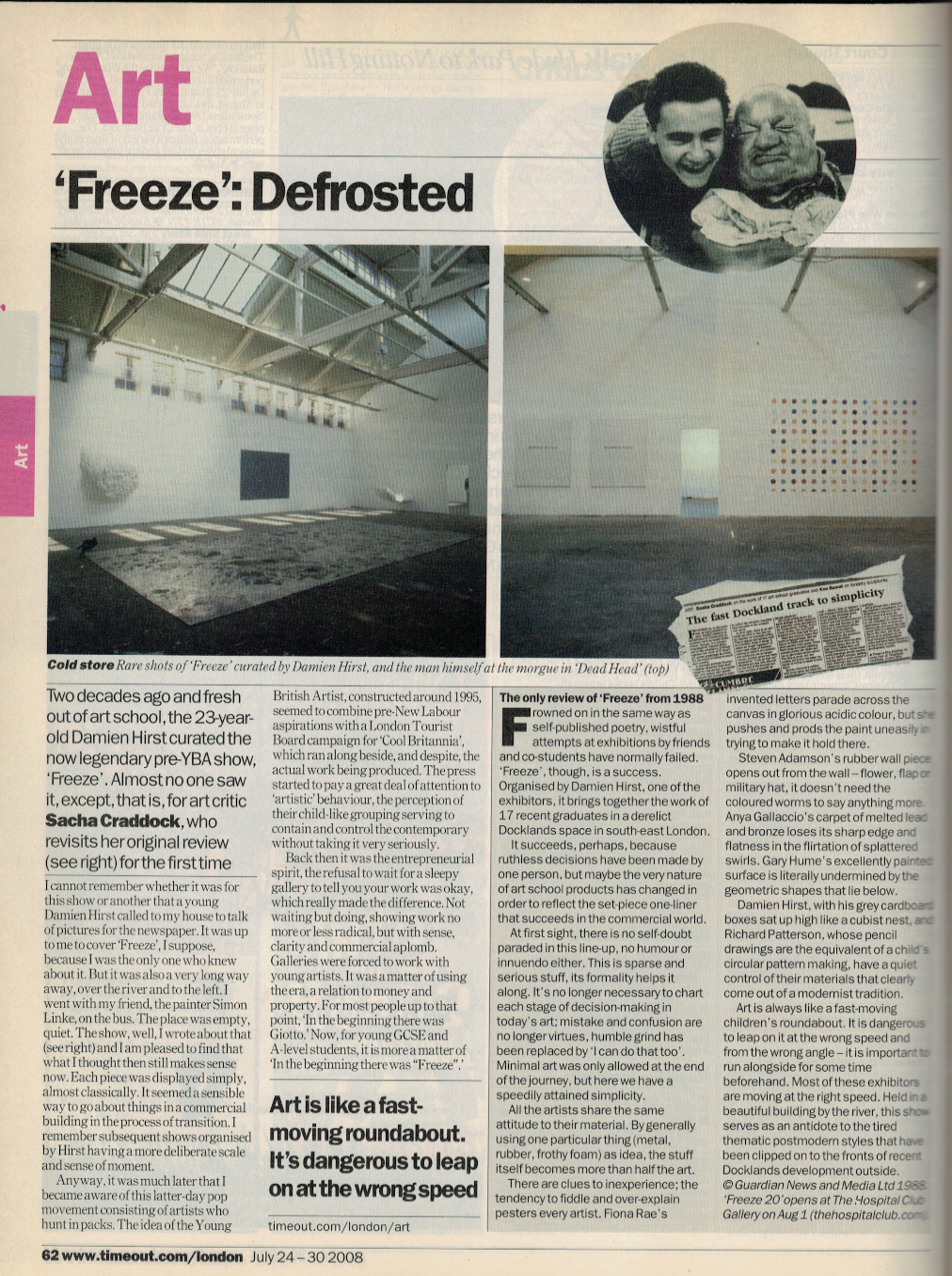
Two decades ago and fresh out of art school, the 23-year-old Damien Hirst curated the now legendary pre-YBA show, ‘Freeze’. Almost no one saw it, except, that is, for art critic Sacha Craddock, who revisits her original review (see right) for the first time
I cannot remember whether it was for this show or another that young Damien Hirst called to my house to talk of pictures for the newspaper. It was up to me to cover ‘Freeze’, I suppose, because I was the only one who knew about it. But it was also a very long way away, over the river and to the left. I went with my friend, the painter Simon Linke, on the bus. The place was empty, quiet. The show, well, I wrote about that (see right) and I am pleased to find that what I thought then still makes sense now. Each piece was displayed simply, almost classically. It seemed a sensible way to go about things in a commercial building in the process of transition. I remember subsequent shows organised by Hirst having a more deliberate scale and sense of moment.
Anyway, it was much later that I became aware of this latter-day pop movement consisting of artists who hunt in packs. The idea of the Young British Artist, constructed around 1995, seemed to combine pre-New Labour aspirations with a London Tourist Board campaign for ‘Cool Britannia’, which ran along beside, and despite, the actual work being produced. The press started to pay a great deal of attention to ‘artistic’ behaviour, the perception of their child-like grouping serving to contain and control the contemporary without taking it very seriously.
Back then it was the entrepreneurial spirit, the refusal to wait for a sleepy gallery to tell you your work was okay, which really made the difference. Not waiting but doing, showing work no more or less radical, but with sense, clarity and commercial aplomb. Galleries were forced to work with young artists. It was a matter of using the era, a relation to money and property. For most people up to that point, ‘In the beginning there was Giotto.’ Now, for young GCSE and A-level students, it is more a matter of ‘In the beginning there was “Freeze”.’
Art is like a fast-moving roundabout. It’s dangerous to leap on at the wrong speed
The only review of ‘Freeze’ from 1988
Frowned on in the same way as self-published poetry, wistful attempts at exhibitions by friends and co-students have normally failed. ‘Freeze’, though, is a success.
Organised by Damien Hirst, one of the exhibitors, it brings together the work of 17 recent graduates in a derelict Docklands space in south-east London.
It succeeds, perhaps, because ruthless decisions have been made by one person, but maybe the very nature of art school products has changed in order to reflect the set-piece one-liner that succeeds in the commercial world.
At first sight, there is no self-doubt paraded in this line-up, no humour or innuendo either. This is sparse and serious stuff, its formality helps it along. It’s no longer necessary to chart each stage of decision-making in today’s art; mistake and confusion are no longer virtues, humble grind has been replaced by ‘I can do that too’. Minimal art was only allowed at the end of the journey, but here we have a speedily attained simplicity.
All the artists share the same attitude to their material. By generally using one particular thing (metal, rubber, frothy foam) as idea, the stuff itself becomes more than half the art.
There are clues to inexperience; the tendency to fiddle and over-explain pesters every artist. Fiona Rae’s invented letters parade across the canvas in glorious acidic colour, but she pushes and prods the paint uneasily in trying to make it hold there.
Steven Adamson’s rubber wall piece opens out from the wall – flower, flap or military hat, it doesn’t need coloured worms to say anything more. Anya Gallaccio’s carpet of melted lead and bronze loses its sharp edge and flatness in the flirtation of splattered swirls. Gary Hume’s excellently painted surface is literally undermined by the geometric shapes that lie below.
Damien Hirst, with his grey cardboard boxes sat up high like a cubist nest, and Richard Patterson, whose pencil drawings are the equivalent of a child’s circular pattern making, have a quiet control of their materials that clearly come out of a modernist tradition.
Art is always like a fast-moving children’s roundabout. It is dangerous to leap on it at the wrong speed and from the wrong angle – it is important to run alongside for some time beforehand. Most of these exhibitors are moving at the right speed. Held in a beautiful building by the river, this show serves as an antidote to the tired thematic postmodern styles that have been clipped on to the fronts of recent Docklands development outside.
© Guardian News and Media Ltd 1988
‘Freeze 20 Opens at The Hospital Club Gallery on Aug 1 (thehospitalclub.com)’
July 24–30, 2008